Green & Black's built its reputation as the ethical, organic alternative to mainstream chocolate. But the brand has changed hands several times since its founding — and understanding who owns it now, what the organic certification actually covers, and what the sugar content really looks like gives a more complete picture than the packaging alone.
The Origins — and the Acquisition
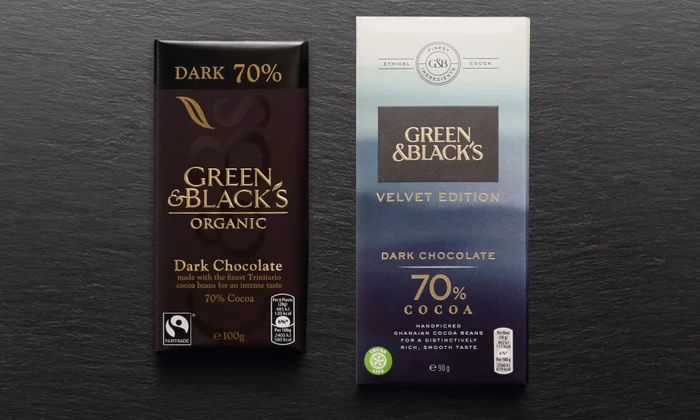
Green & Black's was founded in London in 1991 by Craig Sams and Josephine Fairley — genuinely ahead of its time as an organic, ethically sourced chocolate brand. It was the first product in the UK to carry the Fairtrade mark, and its 70% Maya Gold dark chocolate became a benchmark for quality dark chocolate in the British and Irish market.
In 2005, Cadbury acquired the brand. In 2010, Kraft acquired Cadbury — and Green & Black's passed with it. Kraft subsequently spun off its snacking division as Mondelez International, which now owns Green & Black's alongside Cadbury, Milka, Oreo, Toblerone, and most other major global confectionery brands.
This matters because Mondelez is a global corporation optimised for cost efficiency and shareholder returns — the opposite of what Green & Black's was founded to represent. Brand acquisitions by major food corporations frequently result in reformulations, cost reductions, and the gradual dilution of original quality standards.
Is the Organic Certification Still Valid?
The short answer is: for the core dark chocolate range, yes — at time of writing, Green & Black's dark chocolate products retain organic certification. The cacao used is certified organic, meaning it was grown without synthetic pesticides, herbicides, or GMOs.
However there are important nuances:
- Not all Green & Black's products carry organic certification — always check the current label for the Soil Association or equivalent mark
- Organic certification covers the cacao sourcing — it does not mean the product is free from all additives or that every ingredient is organic
- The brand has reformulated products over the years since the Mondelez acquisition — ingredients and certification status can change
- Some seasonal and limited edition lines have been launched without organic certification
What the Label Actually Shows — Sugar Content
One of the most important things to understand about Green & Black's is that organic does not mean low sugar. Here's how the range looks by carbohydrate content per 100g:
The milk organic bar at 12 teaspoons of sugar equivalent sits alongside Dairy Milk in sugar terms. It is organic — but it is not low sugar. The 85% dark is where the combination of organic sourcing and meaningful cacao content comes together most effectively.
The Ingredient List — Bar by Bar
This is where Green & Black's genuinely earns its reputation — particularly on the dark range. The ingredient lists are short, clean, and entirely organic certified. Here's exactly what's in each bar:
Milk Organic (37%)
Ingredients: Cane sugar, whole milk powder, cocoa mass, cocoa butter, emulsifier (soya lecithins), vanilla extract. All certified organic.
The 37% milk bar is the weakest of the three. Sugar is the first ingredient, soy lecithin appears as an emulsifier, and the cacao content is low enough that the flavanol and antioxidant benefits are minimal. It is organic — but the nutritional profile is comparable to mainstream milk chocolate. The organic sourcing is the meaningful difference here, not the cacao content.
Dark Organic (70%)
Ingredients: Cocoa mass, cane sugar, cocoa butter, vanilla extract. All certified organic.
Four ingredients. No emulsifiers, no palm oil, no artificial flavourings. Cocoa mass leads — meaning cacao is the largest ingredient by weight, with sugar in second place. This is a genuinely clean label. The Fairtrade note indicates cocoa, sugar, and vanilla may be mixed with non-certified equivalents on a mass balance basis — meaning the actual beans in your bar may not all be directly Fairtrade sourced, but an equivalent volume has been purchased through certified supply chains.
Dark Organic (85%)
Ingredients: Cocoa mass, cocoa butter, fat-reduced cocoa powder, cane sugar, vanilla extract. All certified organic.
Five ingredients, with cocoa mass first and cane sugar fourth. The addition of fat-reduced cocoa powder increases the cacao intensity without adding cocoa butter — giving the bar its more bitter, complex character at 85%. No soy lecithin, no palm oil, no emulsifiers of any kind. This is the cleanest bar in the range and the one where the organic sourcing, high cacao content, and short ingredient list all align.
Our Take
Green & Black's 70% and 85% dark chocolate are genuine products — organic cacao, clean ingredient list, no palm oil, and a meaningful step up from mainstream dark chocolate in both quality and nutritional profile. They sit comfortably in the mid-range of the organic dark chocolate market.
The brand's corporate ownership is a legitimate concern for those who care about supporting independent ethical businesses — Mondelez is not that. But if the question is simply whether the chocolate in the wrapper is organic and reasonably clean, the dark range passes that test.
The milk range is a different story — organic credentials aside, the sugar content is comparable to standard mainstream milk chocolate. If you're buying Green & Black's for health reasons, the dark range at 70% or 85% is where the meaningful difference lies.
See how Green & Black's compares to mainstream bars in our full sugar content comparison table.
See the Sugar Table →Frequently Asked Questions
The core dark chocolate range retains organic certification. However not all product lines carry the organic mark, and the brand has been reformulated since its acquisition by Mondelez. Always check the current label for the Soil Association or equivalent certification mark.
Mondelez International — the same corporation that owns Cadbury, Milka, Oreo, and Toblerone. The brand was originally independent, acquired by Cadbury in 2005, and passed to Mondelez when Kraft acquired Cadbury in 2010.
Not all of it. The milk chocolate contains around 48g carbs per 100g — similar to mainstream milk chocolate. The 70% dark is better at 36g, and the 85% dark at 24g is where the organic and low-sugar benefits combine most effectively. Organic certification refers to cacao sourcing, not sugar content.
My Ultimate Chocolate
Your go-to source for healthy dark chocolate recipes, ingredient insights, and the truth about what's really in your favourite bar. We help you make better choices — or better chocolate at home.