Most people have no idea how much sugar is hiding in their chocolate bar — and food manufacturers are counting on that. This isn't about avoiding sugar entirely. It's about understanding the scale. Nobody making chocolate treats at home would consider using anywhere near the quantities of sugar — let alone the industrial ingredients — that go into a mainstream bar.
How Much Sugar Is Hiding in Your Chocolate?
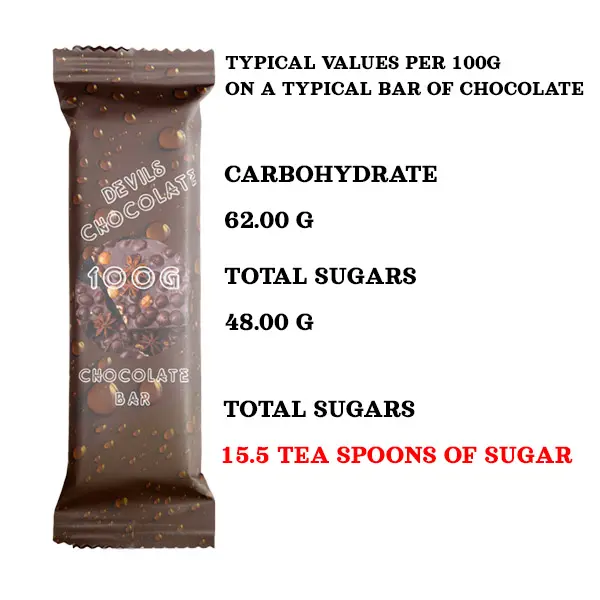
The label on the bar shown above is typical of what you'll find in any Irish supermarket. Here's how the maths works out:
This single bar contains over 15 teaspoons of sugar equivalent. Picture that heaped into a mug. Now picture eating it in one sitting.
Understanding the Label — Where the Carbs Really Come From
EU labelling rules require manufacturers to show two figures: Total Carbohydrates and of which sugars. In the example above, that's 62g total carbs with 48g listed as sugars — leaving 14g unaccounted for.
Those "missing" grams are starches. But here's what the label doesn't tell you: starches are simply long chains of sugar molecules. Once digested, they break down into glucose just like regular sugar. So regardless of how the label splits the figures, your body is processing 62g of glucose.
It gets even more misleading with products marketed as healthy. You might see something like:
Total Carbohydrates: 45.0g | of which sugars: 2.8g
Sounds good, right? But the sugar hasn't gone anywhere — it's just hidden in the starches. These products exploit labelling loopholes to mask the real impact on your blood sugar.
Carbs to Teaspoons — The Quick Conversion Table
To find how many teaspoons of sugar any bar contains, divide Total Carbohydrates by 4. Here's how common carb figures translate:
| 100g Chocolate Bar | Total Carbs (g) | Sugar Equivalent |
|---|---|---|
| Bar 1 | 10g | 2.5 tsp |
| Bar 2 | 20g | 5 tsp |
| Bar 3 | 30g | 7.5 tsp |
| Bar 4 | 40g | 10 tsp |
| Bar 5 | 50g | 12.5 tsp |
| Bar 6 | 60g | 15 tsp |
| Bar 7 | 70g | 17.5 tsp |
Even a 50g bar delivers 5 teaspoons — before you count any other additives. Some bars exceed 120g, meaning a single sitting could mean 18 to 25 teaspoons of sugar equivalent from one bar.
Why Is This Allowed to Happen?
This isn't an accident. It's the result of decades of misdirection, outdated science, and corporate pressure. We have a system that allows people to think they're eating low-sugar food when they're just eating sugar in a different form — and people are consuming 10 to 20 teaspoons of it as a snack, with no healthy fats or fibre to blunt the impact.
🏭 1. Industry Influence
Big food companies:
- Heavily influence food regulations and labelling policies
- Spend billions marketing high-carb products as "healthy" or "low sugar"
- Fund research that downplays the harm from carbs or redirects blame to fat and salt
Governments are reluctant to:
- Take on massive food corporations with deep lobbying budgets
- Change guidelines that would expose 80% of supermarket food as harmful
Think about it — if every product had to clearly state "15 teaspoons of sugar per 100g" on the front of the pack, how many people would put it back on the shelf?
🫣 2. No Appetite to Acknowledge the Scale of the Problem
If health authorities openly acknowledged that ultra-processed food — combined with industrial quantities of refined carbohydrates — is driving the obesity and metabolic disease crisis, they'd be forced to admit that:
- The food pyramid guidance was flawed for decades
- Millions have been misled about what constitutes a healthy diet
- Much of what lines supermarket shelves bears little resemblance to real food
And that's a political and economic conversation no government wants to lead.
🧾 3. Labelling Laws Focus Only on "Sugars"
EU food regulations require labels to show "Total Carbohydrates" and "of which sugars" — the simple sugars like glucose, fructose, and sucrose. But they don't require manufacturers to separately flag refined starches, even though your body converts them to glucose almost immediately. Most people have no idea that white flour and maltodextrin are just sugar in disguise.
So a consumer sees "5g sugar" and thinks they're making a healthy choice — even though the bar contains 60 to 80g of fast-acting carbohydrates.
🧃 4. Nutrition Education Is Shockingly Poor
- Doctors receive minimal training in real-world nutrition
- Most health professionals still focus on total sugar, not carbohydrate quality
- Public messaging rarely explains the difference between slow and fast carbs
Government-led nutrition education is virtually non-existent. There's no meaningful effort to teach people how to read labels, identify harmful ingredients, or understand metabolic impact. Instead, we get vague slogans like "enjoy as part of a varied and balanced diet", followed by completely unrealistic serving guidelines that no adult — let alone a child — will actually follow.
A 100g chocolate bar packed with sugar and additives might list a recommended serving of just 20g — effectively suggesting you eat one small square at a time. Rather than pushing for better ingredients, the system manages consumer perception through serving size guidance instead.
Want to know exactly what's in your chocolate? Our ingredient guide breaks down every common additive found in mainstream bars.
Read the Ingredient Guide →Frequently Asked Questions
A typical 100g store-bought bar contains 40–62g of total carbohydrates. At 4g per teaspoon, that's 10 to 15 teaspoons of sugar equivalent — before accounting for any starches that break down into glucose.
Labelling laws only require the "of which sugars" line to cover simple sugars. Refined starches don't need to be separately flagged, even though your body converts them to glucose just as fast. This allows products to look low-sugar while still delivering a large glycaemic hit.
Divide the Total Carbohydrates figure by 4. One teaspoon of sugar weighs approximately 4g. A bar with 60g of total carbs = 15 teaspoons of sugar equivalent, regardless of what the "of which sugars" line says.
Effectively yes. Refined starches like white flour and maltodextrin are long chains of sugar molecules. Once digested, they break down into glucose almost as quickly as table sugar, raising blood sugar and triggering an insulin response.
Check the Total Carbohydrates figure — not just "of which sugars." The lower the total carbs, the lower the glycaemic impact. Look for a high cocoa percentage, a short ingredient list, and no refined starches, maltodextrin, or glucose syrup.

My Ultimate Chocolate
Your go-to source for healthy dark chocolate recipes, ingredient insights, and the truth about what's really in your favourite bar. We help you make better choices — or better chocolate at home.